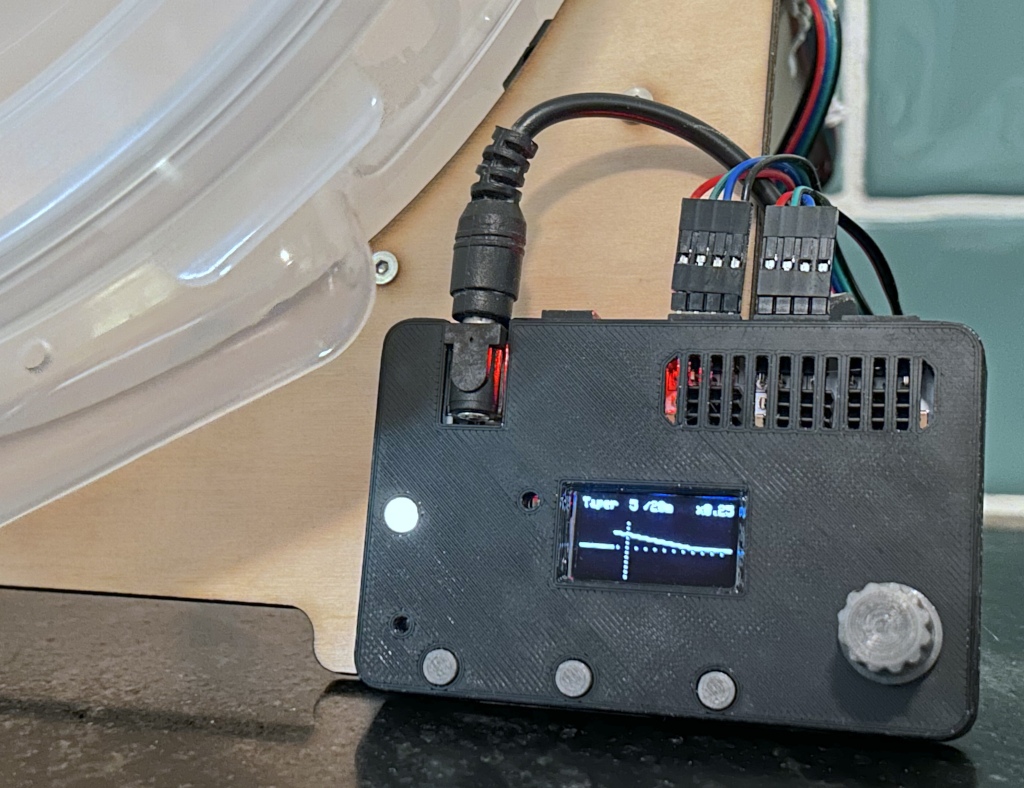
Makeufacturing (#mkfg) builds on the maker movement to form a sustainable maker economy, putting the means of production into the hands of makers themselves to create unique, inventive products and produce them at scale with their own accessible and open source methods.
Makeufacturing leverages maker-level tools and materials to enable scaling up tangible creative efforts while still retaining full control of the process and being able to quickly adapt to local needs and preferences in a way that large-scale manufacturing cannot.
Extensions to the maker approach:
Amplify: Existing maker-level tools are an integral part of small-scale manufacturing; they just require some clever thinking to obtain more efficient operation and improve reliability (via print settings, batch processing, material selection, etc.).
Build: New DIY tools enable automating various parts of production that are tedious, time consuming, labor-intensive, or difficult to manually control (feeding raw materials, processing, bundling, verification, packaging, labeling, etc.).
Conduct: Putting together these new and existing maker tools enables scalable production. See these examples to get a sense for how all of the elements can be combined to support specific MKFG business ventures.
Distribute: Alternative models of distribution provide makers with a way to get their products into customers' hands without the overhead of consignment or leasing brick-and-mortar spaces. Not depending on large online and offline retailers benefits both the maker and the buyer (self-serve, on-site, bulk distribution, direct-to-consumer transactions, pay-what-you-wish pricing, etc.).
Elevate: Getting your first product out the door is just the beginning. Once you're up and running, it's important to consider new ways to improve and grow your makeufacturing venture over time to stay relevant and keep your business working as well as possible.
The Benefits of Makeufacturing
Own Your Means of Production
3D printers, laser cutters, electronics workbenches, and hand tools become your personal factory floor.
Community-Driven Commerce
Sell directly to local and extended communities who value unique, handcrafted, and customizable products.
Low Barrier to Entry
Start with minimal investment, scale gradually, and build sustainable income without corporate overhead.
Economic Independence
Create multiple revenue streams, reduce dependence on traditional employment, and build lasting wealth.
Makeufacturing: The Next Industrial Revolution
The maker movement has demonstrated that individuals can create sophisticated products using accessible tools. Now, we're witnessing its evolution into a maker economy — a decentralized manufacturing ecosystem where creators become entrepreneurs, selling unique products directly to communities that value craftsmanship, customization, and local production.
This transformation represents more than just a business model shift. It's a fundamental reimagining of how we produce, distribute, and consume goods. By democratizing manufacturing through affordable technology — 3D printers under $300, laser cutters accessible through makerspaces, open-source electronics platforms, and abundant online learning resources — we're enabling a new class of micro-manufacturers.
Unlike traditional industrial models that require massive capital investment and create significant barriers to entry, the maker economy operates on principles of accessibility, sustainability, and community. Makers can start with a few hundred dollars in equipment, validate products locally, and scale production based on actual demand rather than speculative manufacturing.
This approach offers displaced workers new pathways to economic stability, provides creatives with direct monetization opportunities, and enables entrepreneurs to launch ventures without traditional corporate structures, massive pay gaps, or prohibitive investment overhead. The result is a more resilient, distributed, and human-centered economy.
While the current tech landscape fixates on artificial intelligence and digital services — technologies that often feel disconnected from tangible human experiences and physical reality — the maker economy represents a return to making things that matter. Contrary to AI solutions that exist purely in the digital realm, maker products are touched, used, and experienced in the real world. They solve immediate physical problems, create lasting objects of beauty, and forge genuine connections between creators and communities.
The makeufacturing movement offers an antidote to our increasingly virtual existence, proving that the future isn't just about what machines can compute, but what humans can create with their hands, minds, and accessible tools.
Making Out
The days of needing to make compelling products inside a large business for job stability and production capabilities are winding down. We are entering an age where thinking outside the box, working outside of corporations, and outwardly expressing our wild ideas can itself become a viable career path.
Making out is the fastest way to directly put your ideas to the test; no pitch meetings to convince shareholders, no year-long production cycle timelines, and no putting valuable creations on a corporate shelf to only watch them collect dust. The power is now in the hands of the makers to develop their work end-to-end; from concept to prototype to manufacturing to sales to community support.
As more individuals and small businesses lean into makeufacturing, there's potential for a global manufacturing renaissance that amplifies the diversity of people's own contributions — directly accessible and uplifting to local communities and capable of operating at a price and quality that can hold its own alongside existing factory production and commercial businesses.
The movement is just getting started — we hope you'll join us!
Getting Started with Makeufacturing
What Will You Makeufacture?
First thing's first... decide what to make!
You can create anything you like, but sometimes it's helpful to see a range of compelling ideas. Get inspired with these randomized suggestions and develop a sense for what tools, processes, pricing, markets and income ranges are possible.
Required Maker Tools & Equipment Makeufacturing Process
Sale Price
Yearly Revenue Range
Market Details
Show another one! ↻
What's a Realistic Timeline & Budget?
Don't quit your day job just yet! Great products take time to develop, refine, and produce, especially when you're making it on your own. Here's a realistic roadmap for building a sustainable makeufacturing business.
Months 1-3: Foundation / $500-3,000 Market research and validation. Acquire basic tools and equipment. Develop first prototype. Set up workspace.
Months 4-6: Launch / $500-1,500 Refine product design. Establish local sales channels. Build initial customer base. Optimize production process.
Year 2+: Expansion / $1,000-10,000+ Upgrade equipment. Hire help or partners. Expand market reach. Develop premium product lines.
Understanding Risks
Beyond the obvious physical risks of building and managing automated machinery, there are also numerous business pitfalls that can tank your venture. Being aware of common gotchas can help you to see them coming and prepare yourself to keep your operation going as smoothly as possible.
High Risk
Health and Safety Incidents Remedy: Invest in proper safety equipment, maintain clean organized workspace, get appropriate insurance coverage, follow industry safety protocols.
Regulatory Compliance Remedy: Research all applicable regulations before starting, maintain proper licenses and certifications, work with legal counsel when needed, join industry associations for guidance.
Scaling Challenges Remedy: Plan for growth systematically, invest in better tools gradually, consider partnerships or hiring help before reaching capacity limits.
Quality Control Issues Remedy: Implement rigorous testing procedures, maintain detailed documentation, and build quality checks into every step of production.
Financial Cash Flow Remedy: Maintain 3-6 months operating expenses in reserve, diversify revenue streams, and implement payment terms that protect cash flow.
Burnout and Work-Life Balance Remedy: Set clear boundaries between work and personal time, build systems to reduce daily decision-making, take regular breaks, consider partnership or hiring help.
Medium Risk
Customer Concentration Risk Remedy: Avoid depending on single large customers, actively diversify your customer base, maintain waiting lists, build strong referral networks.
Economic Recession Impact Remedy: Focus on essential rather than luxury products, build emergency fund, develop lower-cost product lines, consider rental/repair services during downturns.
Raw Material Price Volatility Remedy: Track commodity prices and trends, build material costs into pricing with buffers, consider long-term supplier contracts, design with multiple material options.
Supply Chain Disruptions Remedy: Develop relationships with multiple suppliers, maintain reasonable inventory buffers, and design products with alternative material options.
Technology Obsolescence Remedy: Stay informed about emerging tools and techniques, budget for regular equipment upgrades, and build transferable skills that adapt across technologies.
Seasonal Demand Fluctuations Remedy: Develop complementary product lines for different seasons, build relationships with diverse customer segments, offer services during slow periods.
Low Risk
Digital Marketing Dependency Remedy: Diversify marketing channels beyond social media, build email lists, focus on word-of-mouth and local networking, maintain direct customer relationships.
Market Saturation Remedy: Focus on unique value propositions, custom solutions, and exceptional customer service. Continuously innovate and adapt to market needs.
Intellectual Property Theft Remedy: Document your original designs, consider trademark/patent protection for key innovations, use non-disclosure agreements, focus on execution speed over secrecy.
Open Source & Creative Commons
Makeufacturing is fully open source for you to use, modify, share, hack, etc.
All source code (Arduino projects, C code, web code, scripts, etc.) is released under GNU GPL v3.
Everything else (documentation, images, videos, CAD, drawings, etc.) is released under CC BY-SA 4.0.
The Makeufacturing initiative is made possible by Makefast, a small, family-run prototyping and product development workshop located in Delaware, Ohio. After many attempts at manufacturing our own desktop fabrication products, it became clear how exciting (and technically difficult!) it was to create high quality products at scale out of our home using only DIY/Maker-level tools. We decided to openly catalog and share these learnings in the hopes that other makers around the world may benefit and further grow this new, highly accessible, industrial revolution.
If you appreciate this approach and want to see it grow, please consider contributing below. Your financial support allows us to put more time and effort into makeufacturing so that more people can make more awesome things in more parts of the world!
Safety Disclaimer: Working with automated equipment, electronics, power tools, hazardous chemicals, and DIY manufacturing systems requires proper precautions. Always wear appropriate safety gear including eye protection, gloves, and respiratory equipment when needed. Consult qualified professionals before working with electrical systems, chemicals, or complex machinery. Keep bystanders clear of operating equipment. Never leave automated systems unattended during operation. Ensure proper ventilation when working with fumes, dust, or chemical vapors. This information is for educational purposes only and does not replace professional safety training or equipment manufacturer instructions. This site and its contributors will not be held liable. Use at your own risk.
Be safe, have fun, and keep making awesome things!